
Buffett's Most Important Lesson
Defer taxes, multiply your return

In Berkshire Hathaway’s 1989 shareholder letter, Warren Buffett made an amazing case for long-term investing.
If you only read one excerpt from an old Buffett letter this year, make it this one.
Imagine that Berkshire had only $1, which we put in a security that doubled by year end and was then sold. Imagine further that we used the after-tax proceeds to repeat this process in each of the next 19 years, scoring a double each time.
At the end of the 20 years, the 34% capital gains tax that we would have paid on the profits from each sale would have delivered about $13,000 to the government and we would be left with about $25,250.
Not bad. If, however, we made a single fantastic investment that itself doubled 20 times during the 20 years, our dollar would grow to $1,048,576. Were we then to cash out, we would pay a 34% tax of roughly $356,500 and be left with about $692,000.
The sole reason for this staggering difference in results would be the timing of tax payments. Interestingly, the government would gain from Scenario 2 in exactly the same 27:1 ratio as we—taking in taxes of $356,500 vs. $13,000—though, admittedly, it would have to wait for its money.
Taxes are everything when it comes to investing. If you hold quality assets long-term, your money has time to properly compound.
Frequent traders who pay taxes on gains every year are essentially negatively compounding their money. Unless, of course, they wildly outperform the market. But I’d guess 90% significantly underperform.
What May Work Long-Term Today?
I continue to believe that gold and silver should have a large allocation in every portfolio today. 25% is what I’m aiming for.
I think precious metals are a very durable trade, and expect to hold them for at least 10 years. Our financial problems are not going away anytime soon.
What else? I think we may get a nice chance to buy oil and gas companies sometime over the next few months. I own some now and will be looking to buy more if markets crack.
Fossil fuels should also be a durable trade. We’re about to learn just how much our economy depends on them, and will going forward.
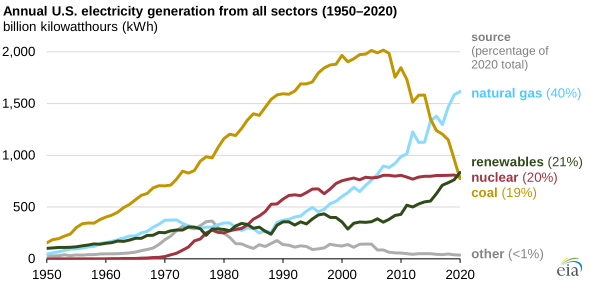
It will be interesting to see how dramatic the uptick in coal use becomes.
Startups & US Industry
Startups are the ultimate long-term investment, because you basically can’t sell them until they’re huge. No discipline required really. Unfortunately deal prices remain mostly crazy, but are finally heading down. I look forward to more reasonable valuations in the future.
US manufacturing is an interesting one, but I think we’re still too early there. Costs are still too high, and regulations are too complex and counterproductive. We will probably need major political change before this becomes viable.
Eventually though, America’s re-industrialization will be a tremendous opportunity.

Emerging Markets?
One potential long-term investment I have been bullish on, emerging markets, is a bit cloudier today. I still like EM in theory.
But most broad emerging market funds, such as Vanguard’s VWO, have high exposure to China. If this economic war continues, owning Chinese stocks may become non-viable at some point (as we saw with Russian ADRs/ETFs).
Then again, if it gets to the point of de-listing Chinese stocks from Western markets, we’ll likely have larger things to worry about.
If the Fed keeps hiking for a bit, EM stocks may become too attractive to ignore at some point.